A Goal Needs a Direction and a Next Action
A goal needs a direction and a next action. Connect the change you want with one visible move, then use what happens to choose what comes next.
The most common mistake with a goal is treating the destination as the task. “Get better at writing” names a direction, but it does not tell you what to do when you sit down at your desk. That gap costs attention: you spend the moment meant for starting deciding what starting means.
A goal needs a direction and a next action, but those are different things. Direction describes the change you want to move toward. The next action is a specific, observable move that can begin from where you are now. Connect them, and an aim becomes easier to begin and easier to review without pretending the whole outcome is under your control.
Direction and action
A direction gives a goal meaning beyond the next task. It might be “feel more confident speaking Spanish,” “make my household budget easier to understand,” or “build a body of illustration work.” These statements help you judge whether a task belongs. They are not useful as instructions by themselves, because each could lead to many different actions.
A next action is something you can see yourself do: open a particular document, draft a rough paragraph, list recurring expenses, or sketch one object from observation. It should describe your contribution, not a result that depends on other people or unpredictable conditions. “Get hired” is an outcome; “revise the opening section of my résumé for the role I want” is an action.
Keep the two connected. If the action cannot plausibly support the direction, it may be busywork. If the direction cannot help you choose among possible actions, it may be too vague. The useful middle ground is a direction broad enough to guide choices and an action narrow enough to start.
Three useful approaches
There is no single best format for every aim. Choose among a concrete milestone, a small experiment, or a recurring contribution. Each makes a different kind of uncertainty easier to handle.
Concrete milestone
A milestone names a result you can inspect, such as assembling a portfolio draft or completing a first version of a household spending plan. The next action should make progress toward that visible result: choose the pieces for the portfolio, or gather the account statements and bills that belong in the plan.
This approach suits you when the direction already has a fairly clear shape and you can identify what would count as a meaningful draft. It helps prevent a project from staying abstract. Its weakness is that a milestone can become another distant destination if you write the result but leave out the first move.
Small experiment
An experiment is a limited action intended to teach you something. If you are unsure whether you want to pursue public speaking, you might outline a short talk and deliver it to a supportive group. The purpose is not to declare success or failure. It is to learn whether the work, setting, and direction fit well enough to continue.
Choose this approach when you lack information, feel torn between options, or are tempted to plan a large commitment before trying a small version. Keep the question specific. “Would I like to practice explaining a topic aloud?” is more useful than “Is public speaking right for me?” because the smaller question points to an action and an observable response.
Recurring contribution
A recurring contribution is a manageable action you can repeat while the direction stays in view. It could be adding a short draft to a writing project, reviewing a section of study notes, or making one sketch. The point is that a steady contribution can produce visible material to inspect.
This suits you when the aim requires a body of work or gradual accumulation, and no single early milestone will tell the whole story. It is less useful when you are uncertain that the direction fits, or when repeating the same contribution no longer teaches you anything. In those cases, an experiment or milestone may provide better information.
Choosing an approach
Start by naming what you do not know. If you know what you want to make but the project feels large, choose a milestone and name its first component. If you are unsure whether the direction fits, choose an experiment that tests one part of it. If the direction feels right and the work accumulates gradually, choose a recurring contribution that leaves something visible to review.
Use these checks to make the choice. For each observation, follow the decision that fits; if the other condition applies, use the alternative action.
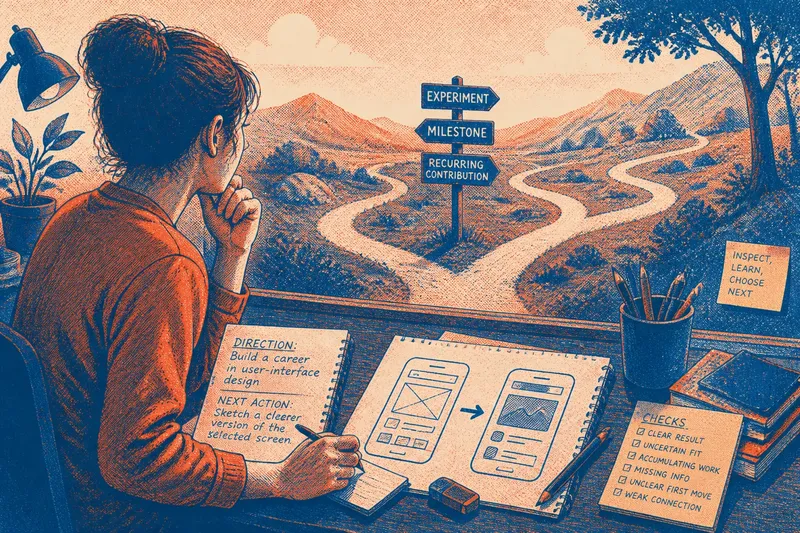
- Clear result: If you can describe a useful draft or finished component, choose a milestone; if you cannot, define a smaller result or use an experiment to clarify the direction.
- Uncertain fit: If you do not know whether the work suits you, run a limited experiment; if the direction already feels sound, choose a milestone or recurring contribution instead.
- Accumulating work: If progress means producing several pieces over time, choose a recurring contribution; if one visible result would settle the immediate question, choose a milestone.
- Missing information: If a decision depends on an answer you do not have, choose an action that can produce that information; if the needed information is already available, act on it rather than gathering more.
- Unclear first move: If you cannot picture how to begin, name the first material or decision you need; if you can picture the start, write that action down and leave smaller movements untracked.
- Weak connection: If the action would not support the direction or teach you something relevant, replace it; if the connection is clear, keep the action and identify what you will inspect afterward.
Say you want to move toward a career in user-interface design but have not tried the work. Your starting inputs are a personal project with a confusing screen, a pencil, and uncertainty about whether you enjoy improving interfaces. First, select that screen and sketch a clearer version. Next, ask a trusted peer what they understand from the sketch. The result is a visible design and feedback to consider: if the work interests you, choose a small portfolio case study as a milestone; if it does not, keep the career decision open and try a different kind of design task before committing further.
When two approaches seem equally plausible, prefer the one that answers the most important open question with the least unnecessary preparation. Do not make every aim tiny; keep planning proportional to what you need to learn.
Writing the next action
Before you leave a planning session, write the direction and action separately. Use these prompts:
- Direction: What change or capability do I want to move toward?
- Approach: Am I building toward a milestone, testing an uncertainty, or making a recurring contribution?
- Action: What visible move will I make next?
- Evidence: What will exist or be observable when I finish?
- Choice point: What will I decide after looking at that evidence?
Make the action concrete enough that you can picture its beginning. “Work on my portfolio” leaves the first decision open. “Choose three draft pieces and put them in one folder” closes that gap. “Think about my finances” is also broad; “list the recurring bills I can identify” gives you a visible page to work from.
Do not add elaborate tracking unless it helps you make a decision. A note in a paper notebook, a task in a basic phone list, or a line in a project document is usually enough to hold the direction and next move together. Color-coded boards, elaborate dashboards, and finely divided categories are not worth the effort when they record activity but do not clarify what to do next.
Reviewing the connection?
What if my direction is vague?
Describe the kind of change you want in ordinary language, then add a clue that would make it visible. “Become more organized” might become “make it easier to find the documents I use for taxes.” You do not need a polished destination; you need enough meaning to choose a useful first move.
What if the next action feels too big?
Look for the first decision or material needed inside it. “Create a portfolio” could begin with choosing one project to examine, while “learn Spanish” could begin with selecting a conversation topic and gathering phrases for it. Split the action only until you can see how to begin; avoid turning every minor movement into a separate task.
How do I know if the action fits?
Ask whether completing it will move the project forward or give you information relevant to the direction. If neither is true, revise the action. A task can be useful preparation, but it should have a clear reason for belonging to this aim rather than merely feeling productive.
When should I change the plan?
Review the connection after the action, when you have something concrete to consider. Keep the direction if it still matters, adjust the action if it was poorly chosen, or change the direction if the result gives you a sound reason to reconsider. A plan is a decision aid, not a promise to ignore what you learn.
Using what you learn
Reviewing an action does not require a verdict on your character or potential. Ask what you did, what you can now see, and which choice follows. If a draft exists, decide what to revise. If an experiment left you curious, try a more substantial version. If the action exposed a missing skill or resource, make the next move address that gap.
Use the same distinction when an action does not happen. The direction may still matter, while the action may have been unclear, inconvenient, or dependent on something unavailable. Identify which part needs changing before replacing the whole aim. A smaller or better-timed action may be enough; sometimes the direction itself needs another look.
For aims that touch health, money, legal obligations, or safety, keep decisions within your knowledge and seek qualified professional advice where appropriate. A next action can be as simple as preparing questions for a relevant professional, rather than trying to settle a consequential issue alone.
A goal needs a direction and a next action because they answer different questions: where are you trying to move, and what can you do from here? Write both beside each other, then choose the approach that fits what you know and what remains uncertain. When you finish the action, use what is visible to choose the next one. The phrase “goal direction and next action” is useful only if it leads to a clear decision you can make today.