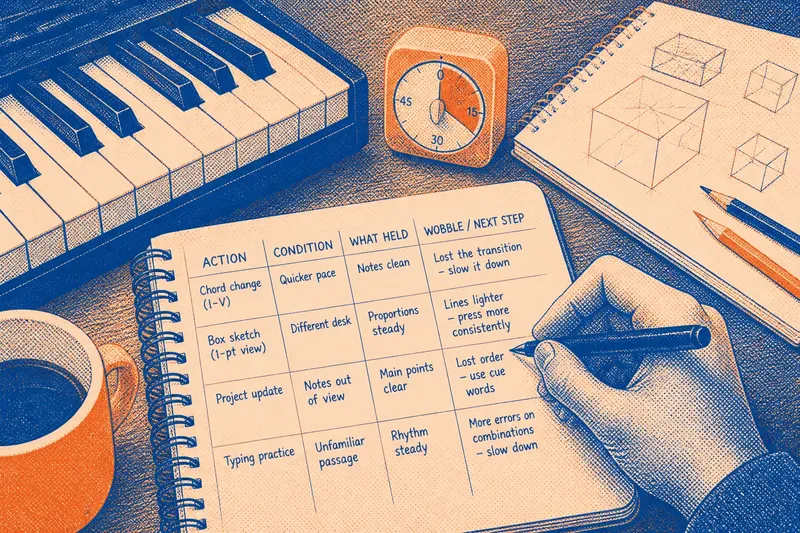
The Missed-Day Myth: A Pause Does Not Erase a Routine
A missed day does not erase a routine. Learn to understand the interruption, adjust your plan, and return without turning one pause into a restart from zero.
The most common mistake after a missed day is declaring the routine broken. That judgment can cost more than the pause itself: it turns a small interruption into a reason to stop. A missed day does not erase a habit; it leaves a gap you can respond to.
When you miss a planned action, treat the event as information. What got in the way? Was the plan too demanding, or did an unusual day disrupt it? The answer can help you make a useful adjustment. It does not have to become a verdict on your discipline.
What a pause means
A routine is a pattern you return to, not a perfect chain that loses all value when one link is absent. If you usually write in a journal and skip a day, the next entry can still belong to the same routine. The gap is real, but it does not wipe out the earlier practice or make the next action meaningless.
This distinction matters because habits are carried by decisions you can make again. You can choose to resume at the next suitable opportunity. You do not need to recreate every missed action, repay a debt, or wait for a fresh week to begin.
Some pauses are deliberate. You might miss a run because you are ill, take a break from studying while traveling, or skip a creative session to meet another responsibility. Other interruptions arrive without warning. In either case, ask what kind of return makes sense now.
Missed-day habit adjustments
A lapse can point to a mismatch between your plan and your circumstances. Perhaps your evening reading routine depends on having energy after a demanding day. Perhaps you intend to practice a language but cannot find your notes when you have a spare moment. These are different problems, and a general promise to “try harder” does not address either one.
Look at the immediate context rather than searching for a character flaw. Consider what you expected to happen, what actually happened, and what small change might help next time. Keep the review plain. If rain made your usual walking route unpleasant, the useful adjustment may be choosing an indoor option, not judging your discipline.
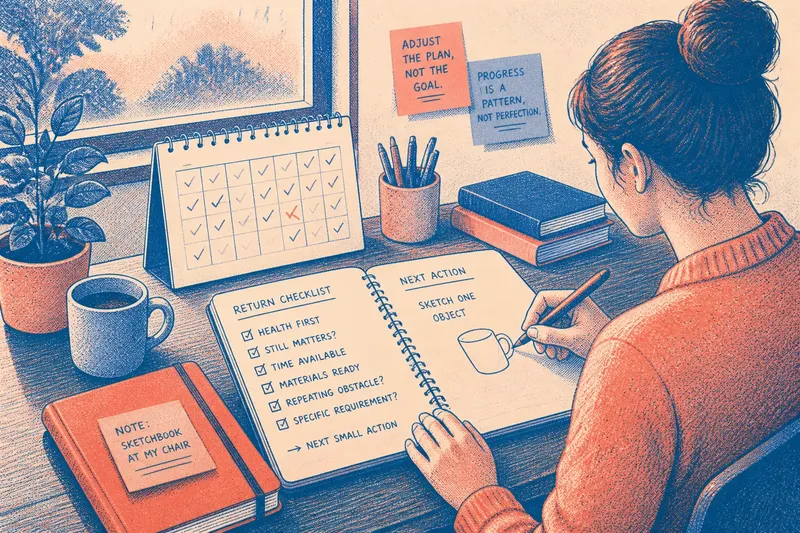
Say you planned to sketch after dinner, but a family call took the time you had set aside. The next day, you notice that the sketchbook is stored in another room and easy to forget. You move it beside your usual chair and plan to draw one object at the next available session. Then check whether the sketchbook is within reach and whether you begin; the point is to make starting easier, not to prove interruptions will never happen again.
A return checklist
Use these checks to choose a sensible next action. For each observation, make the decision that fits instead of applying the same response to every lapse.
- Check whether you are ill, in pain, or facing a safety concern. If so, pause the activity and follow appropriate guidance; otherwise, consider a manageable return.
- Check whether the original activity still matters to you. If it does, keep the aim and adjust the plan if needed; if it does not, reconsider the aim rather than forcing the routine.
- Check how much time is available at the next opportunity. If the usual session fits, resume it; if it does not, choose a smaller version or a realistic later time.
- Check whether the needed materials are easy to reach. If they are, use them at the next cue; if not, put them where you will see them or prepare an alternative.
- Check whether the same obstacle has interrupted the routine more than once. If it has, change the timing, setting, or scope; if it has not, treat the interruption as a single event and move on.
- Check whether the activity has a specific requirement, such as a course deadline or clinician’s advice. If it does, follow that requirement or ask a qualified professional; if it does not, avoid adding make-up work by default.
Return without repayment
After a gap, resume with the next reasonable version of the habit. If your usual action is too large for the day you have, choose a smaller one that still belongs to the same activity. Read a few pages instead of a full chapter, or review your notes briefly instead of planning a long study session. The point is to re-enter the routine, not to recreate a perfect day.
Avoid doubling the next session to compensate. Extra work can make the habit feel like a penalty, especially if the pause had a good reason. It can also create another obstacle: the next action seems so demanding that you postpone it. Return at a manageable level, then decide later whether the usual version still fits.
It is also sensible to wait when rest or recovery is the better choice. Resuming does not mean ignoring pain, illness, or a serious obligation. If the activity involves health, safety, or professional training, follow relevant guidance and ask a qualified professional when needed.
When should you resume?
Should I restart after one missed day?
No. Continue from the next suitable opportunity rather than treating the gap as a reset. Focus on the next action, not on maintaining a perfect record.
What if I have missed several days?
Look for a workable point of return and choose a version that fits your current circumstances. A longer pause may call for a gentler re-entry, but it does not require self-punishment or a dramatic restart.
Should I make up what I missed?
Usually, there is no need to stack missed actions onto a later session. Resume at a manageable level unless the activity has a specific requirement, such as a course deadline or clinician’s advice.
What if the same obstacle keeps appearing?
Repeated interruptions suggest that the plan may need changing. Identify the recurring friction, then adjust the timing, materials, scope, or setting instead of repeating a promise that has not worked.
Separate pattern from verdict
One interruption is a single event. A recurring pattern is a reason to examine the design of the routine. If you repeatedly miss an action because it takes longer than you have, shrink or reschedule it. If you miss it because the activity no longer matters to you, consider whether the aim still deserves a place in your life.
Use a brief note if the reason is easy to forget. Write something concrete, such as “the notebook was in my work bag” or “I had no quiet place after dinner.” Skip labels like “lazy” or “bad at routines.” A useful note describes a condition you can respond to; a label only makes the next attempt feel heavier.
Not every pause needs an investigation. If you know what happened and the routine still fits, return and move on. It is not worth building a detailed tracking system to explain an ordinary disruption. Keep a note only when it helps you make a practical decision.
Make returning easier
Choose a clear restart point before the next interruption. That might be the next scheduled practice, the next time you make coffee, or the next day you have the right materials. A specific cue gives you a place to begin without requiring a new plan from scratch. Keep it flexible enough to account for real constraints.
You can also make a smaller version of the habit available. Keep a short reading selection, a simple practice prompt, or the relevant supplies easy to reach. This is not a demand to do the smallest possible version forever. It is a route back when your time or energy is limited.
Pay attention to what happens when you resume. Did the smaller action help you begin? Was the original plan still suitable? If the same barrier returns, revise the plan again. The goal is not to eliminate every pause, but to make the routine responsive enough that a pause does not become a permanent exit.
Keep the routine available
A missed day does not erase a routine; it gives you a moment to decide what happens next. Treat the gap as information, return without repayment, and change the plan only when circumstances call for it. For a missed-day habit, the useful measure is whether you can make the next sensible choice, not whether every planned action happened on schedule.