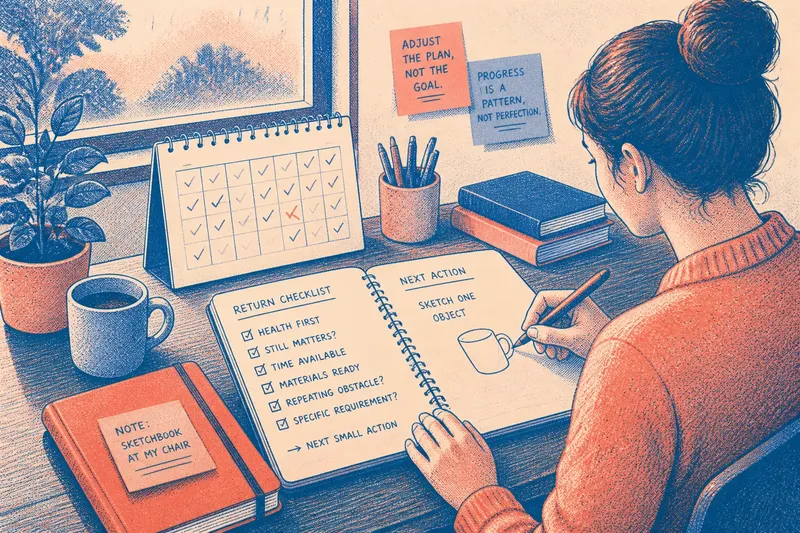
From Repetition to Variation: How Skill Practice Changes
Skill practice becomes more useful when steady repetition gives way to small variations, helping you spot which parts of an action hold up under change.
The common mistake in skill practice is repeating the same action after it has become familiar. That can make a performance feel smooth while leaving you unsure what to do when the pace, tool, surface, or prompt changes. Skill practice grows more adaptable when you first make the basic action reliable, then vary one condition at a time.
Build a steady version
Start by choosing a small action you can repeat and observe. For a beginner pianist, that might be moving between two chords. For someone learning to draw, it could be sketching a simple box from one fixed viewpoint. Keep the task narrow enough that you can tell what happened without judging your whole ability.
Set a clear cue for a satisfactory attempt. In a chord change, the cue might be that each note sounds clean and the hand lands in the intended position. In a sketch, it might be that the lines meet at the intended corners. Use an observable signal rather than “It felt good,” which can shift with mood or fatigue.
Repeat the action at an unhurried pace. Notice where attention goes, which part feels dependable, and where you tend to hesitate. If the result changes from attempt to attempt, stay with the basic version and make the action easier: slow the tempo, simplify the drawing, or reduce the number of moving parts.
Do not chase flawless repetition. The aim is a recognizable starting point, not a performance that never wobbles. A small, repeatable action gives you something useful to compare against when you begin changing its conditions.
Change one condition
Once the basic action is reasonably steady, alter one feature while keeping the rest familiar. Change the speed, order, location, input, or amount of time available. If several conditions shift at once, it becomes hard to tell what challenged the skill.
- Speed: Try the same sequence more slowly, then at a modestly quicker pace.
- Order: Begin at a different point or reverse the sequence.
- Location: Practice in another room or at a different desk while keeping your tools the same.
- Prompt: Work from a brief cue rather than a complete model, if that fits the skill.
- Pause: Leave a gap between attempts, then see whether you can restart without rebuilding the whole sequence.
Pick a variation that resembles a situation you might actually face. A person learning to type could alternate between familiar words and a short passage with unfamiliar combinations. Someone practicing a spoken introduction could change the listener or setting while keeping the main points intact. These changes test whether the learner can use the skill, not merely replay a memorized route.
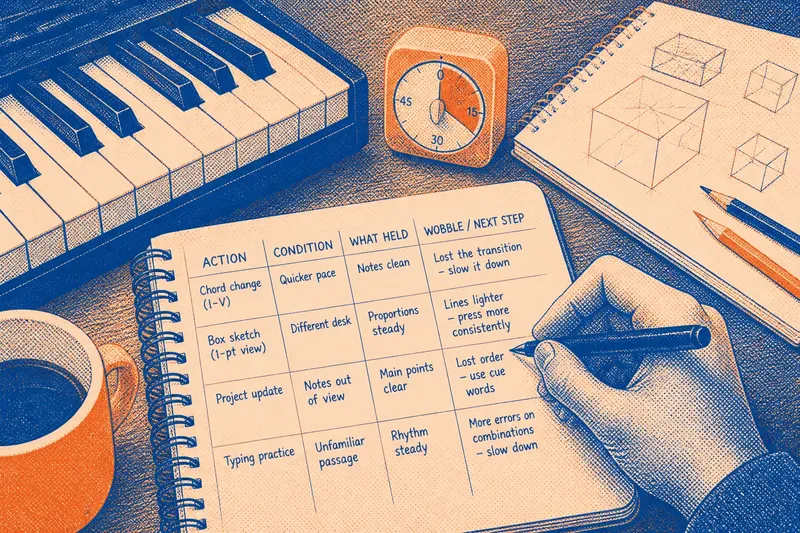
Keep a note of the condition and the result. A few words are enough: “quicker pace—lost the transition,” or “new desk—kept the sequence.” This is more useful than a broad rating because it identifies what changed and what stayed dependable.
Read the wobble
A less smooth attempt is information, not automatic evidence that practice has failed. The useful question is specific: did the change expose a weak link, or did it make the task so unfamiliar that the original skill was hard to recognize?
Look for the point where the action breaks down. In a drawing, the proportions might drift when the viewing angle changes. In a recipe, the sequence may remain clear while timing becomes uncertain. Name the affected part, then return to a simpler variation that lets you work on it without discarding the rest of the skill.
Do not correct every wobble at once. If a pianist rushes a transition when the tempo increases, return to the same chords at a manageable pace and focus on that transition. Then try the faster version again. The goal is to connect the reliable movement to the new condition, not to add a stack of corrections that compete for attention.
Also notice what holds. If the sequence remains accurate but takes longer, that is different from losing the sequence entirely. Separating these outcomes helps you choose the next practice condition instead of treating every imperfect result as the same problem.
Choose the next variation
Use the result to decide whether to repeat, simplify, or add another change. Repeat the same variation when you are still learning what it asks of you. Simplify it when the basic action disappears. Add a second condition only after you can describe what the first one changed.
Imagine you are learning to give a short project update. You can deliver the main points while reading notes, but lose your place when the notes are put aside. Keep the topic and setting the same, shorten the notes to a few cue words, and notice whether the main sequence remains clear. If it does, practice with the notes farther out of view; if it does not, return to the fuller prompts and work on recalling the sequence before changing the setting too.
That choice matters more than making each attempt harder. A variation should reveal something you can act on. If you cannot tell what it revealed, change one condition back and make the comparison clearer.
What should vary next?
How do I know when to add variation?
Add a small change when you can repeat the basic action and identify its usual sticking point. You do not need perfect consistency; you need a clear enough baseline to notice what the changed condition affects.
Should I practice slowly or at normal speed?
Use a pace that lets you carry out the action and notice its parts. Slow practice can make a transition easier to observe, while a more natural pace can show whether the whole sequence holds together.
What if the varied attempt goes badly?
Return to the last version you could manage, then make the variation smaller. Keep the observation specific, such as “lost the order when the prompt changed,” rather than concluding that you cannot do the skill.
How many conditions should I change at once?
Change one at first so you can link the result to a cause. Later, combine conditions that you have already practiced separately when doing so resembles the real task you want to handle.
Keep the comparison useful
Short notes can make practice easier to steer. Record the action, the condition you changed, what remained reliable, and where the action faltered. You can use a paper notebook, a notes app, or a simple table; the format matters less than being able to compare attempts.
Be cautious about comparing sessions that differ in several ways. A new room, a harder prompt, and a faster pace may each affect the result. Keep your notes plain, and avoid turning them into a score that hides the detail you need for the next decision.
What is not worth the effort: designing an elaborate practice log before you know what you need to notice. A short note about one changed condition is usually enough to choose a useful next attempt.
Skill practice becomes more flexible when repetition serves as a reference point rather than a destination. For your next session, choose one small action, establish what a reliable attempt looks like, and change one condition. The detail that survives the change is a practical clue about what your skill can already carry into a new situation.