A Month-End Review for Plans That Have Shifted
A month-end review helps you sort changed priorities from outdated commitments and choose one adjustment that makes next month more workable.
The common month-end mistake is judging a plan by whether you followed it, then carrying every unfinished commitment into the next month. That turns changed circumstances into a pile of self-assigned debt. A month-end review can instead help you identify what changed, keep the commitments that still fit, and choose one adjustment for the month ahead.
Set aside a quiet half hour and bring your calendar, task list, and any notes you made during the month. You do not need a perfect record. The point is to make a usable decision, not to reconstruct every day or grade your character.
Start with the record
Scan the month in order, using calendar entries and completed tasks as prompts. Notice changes in time, energy, responsibilities, resources, and priorities. Write down observable changes rather than explanations about what they say about you.
For instance, “two evening classes were added” is more useful than “I’m bad at keeping plans.” One describes a condition you can account for; the other turns a scheduling problem into a verdict.
Use three short columns on paper or in a notes app:
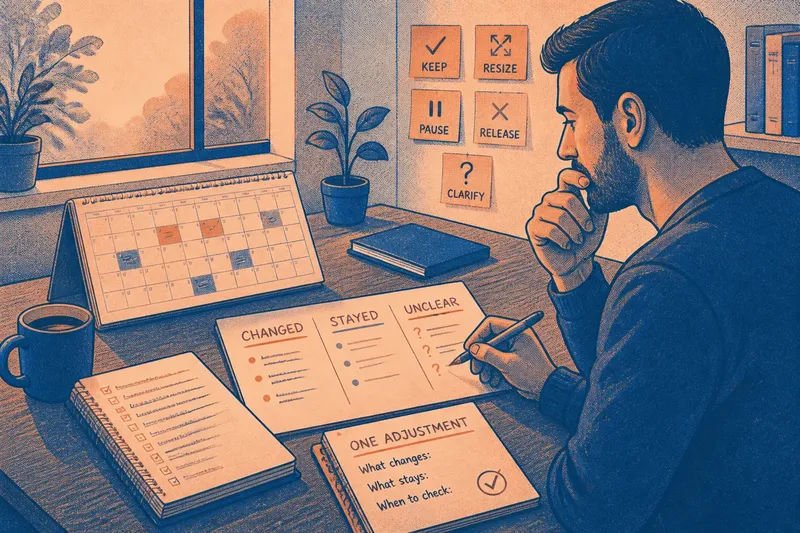
- Changed: What became different from the plan you began with?
- Stayed: What remained true or continued to matter?
- Unclear: What still needs a decision or more information?
Keep entries specific. “Work was busy” may conceal several different issues. “I was asked to cover the late shift on Thursdays” points to a concrete change that could affect a recurring commitment.
Separate change from drift
Not every unfinished task means your circumstances changed. Some plans were interrupted by an event; others gradually stopped getting attention. Distinguishing those cases helps you avoid either blaming yourself for a real constraint or preserving a commitment simply because it has been on the list for a long time.
Look for the first point where the original plan stopped matching your actual week. Was a responsibility added? Did the intended time disappear? Did you learn that the task depended on something unavailable? Or did the commitment remain possible but repeatedly lose out to other choices?
Write down what the calendar or task list can support, then mark your interpretation as a question if you are not sure. “I skipped the writing block on three crowded evenings” is a record. “Writing no longer matters to me” is a conclusion that needs more thought.
This distinction matters because different causes call for different responses. A time conflict may call for a smaller commitment or a different slot. A fading interest may call for pausing the plan, changing its purpose, or deliberately keeping it. Do not use a new schedule to solve a question about whether you want to continue.
Check each commitment
Review recurring plans and unfinished commitments one at a time. For each, ask whether it still matters, whether its purpose is clear, and whether the conditions for doing it still exist. You are not deciding whether the commitment is admirable. You are deciding whether it belongs in the month you are about to enter.
Choose a clear status for each item:
- Keep: It still matters and fits the time and resources you can reasonably give it.
- Resize: Its purpose still matters, but the current version no longer fits.
- Pause: You need to leave it inactive while a temporary constraint remains.
- Release: You no longer choose to spend effort on it.
- Clarify: You cannot decide until you answer a specific question.
For “clarify,” write the question and a time to revisit it. For example, you might need to ask whether a colleague can share a recurring task before deciding whether to keep a weekly commitment. Leaving the item on a general list without naming the open question only makes it harder to review later.
Be careful not to treat “keep” as the default. A commitment can have been worthwhile when you made it and still be wrong for the month ahead. You can recognize its value without carrying it forward.
Build a workable month
Once you have sorted the list, look at the shape of the coming month. Check fixed appointments, known busy periods, travel, caregiving duties, and deadlines. Leave room for ordinary tasks that compete for the same time and attention. A plan that fills every open space is already relying on a month with no interruptions.
Choose the commitments that deserve a place, then state what “doing this” means in terms you can recognize. “Make progress on the course” is hard to evaluate. “Complete the next lesson during the quiet block I have reserved” gives you something concrete to check, without requiring a perfect month.
Say you planned to prepare dinner at home on several work nights, but a new evening responsibility now leaves you getting home late. You still want fewer rushed meals, so you resize the commitment: choose two straightforward meals to prepare on quieter days and keep ingredients for a simple backup. The observable result to look for next month is whether those meals are available when the late evenings arrive—not whether every dinner follows the plan.
That kind of adjustment preserves the purpose while changing the arrangement. It also gives you a fair way to review the choice: compare what you intended to make easier with what actually became easier, then decide whether the arrangement still fits.
Choose one adjustment
Do not redesign your whole life at month-end. Pick one adjustment that addresses a real mismatch and can be noticed during the coming month. It might be reducing the scope of a commitment, moving it away from a known conflict, asking someone to clarify a shared responsibility, or removing an item that no longer belongs.
Write the adjustment as a simple agreement with yourself:
- What changes: Name the commitment or part of the plan.
- What stays: Name the purpose, if it still matters.
- When to check: Choose a point in the coming month to see whether the adjustment fits.
Keep the rest of the plan steady where possible. If you change several unrelated things at once, the next review may not tell you which change helped or created a new problem. The aim is not to control the month; it is to make the next decision easier.
It is not worth color-coding every entry, reconstructing missed hours, or writing a long explanation for every unfinished task. Those activities can consume the time you set aside without improving the decision. Use detail only when it answers a question you genuinely need to resolve.
When should you keep a plan?
How can you tell whether a commitment still fits?
Check whether it still serves a purpose you choose and whether its current demands have a plausible place in the month ahead. If the purpose remains but the demands do not fit, consider resizing it rather than treating the choice as all or nothing.
What if you cannot tell why the plan stalled?
Record what you can observe, such as the times you tried and what was happening then. Leave the cause open until you have enough information to make a useful choice; a tentative question is better than a confident guess about your motives.
Should an unfinished task move into next month?
Move it only after deciding that it still matters and naming when or under what conditions you will return to it. Otherwise, pause, release, or clarify it so the new month does not inherit an unexamined obligation.
What if the next month changes too?
Use the review as a decision point, not a promise that circumstances will stay still. If a major change arrives, revisit the affected commitment and adjust it then instead of waiting for the calendar to turn.
Close the review clearly
End by writing a short note with three parts: what changed, what you are keeping, and the one adjustment you chose. Put the note somewhere you will see it during the month, such as beside your calendar or at the top of your task list. When the month-end review comes around again, you will have a clear reference for the decision you made and the conditions you meant it to address.
A month-end review works best when it leaves you with a lighter, more accurate plan—not a more elaborate record of everything that went wrong. Keep the commitments that still fit, name what needs a different shape, and let the next month test one thoughtful adjustment at a time.